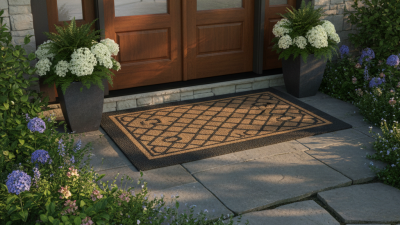

Finding a China top Ribbed Outdoor Door Mat supplier requires more than comparing prices. It requires practical product knowledge, factory experience, and careful evidence. A reliable supplier should understand how ribbed surfaces remove soil from shoes without becoming difficult to clean. The mat should also remain stable near entrances, patios, warehouses, and commercial doors.
Material choice matters. PVC can offer flexible scraping performance and simple maintenance. Rubber may provide stronger grip and better resistance in demanding areas. However, results depend on formulation, backing design, temperature, and production control. Ask for samples.
A professional supplier should explain rib height, mat thickness, edge finishing, drainage, packaging, and available sizes. Clear answers often reveal real manufacturing experience. Product samples should be checked on wet concrete, smooth tiles, and rough outdoor flooring. Watch for curling corners, unpleasant odors, color fading, and movement under foot traffic.
Quality control should cover dimensions, surface bonding, weight, appearance, and batch consistency. Request inspection records, material information, and suitable test reports where available. Certifications can support trust, but they should match the actual product and current market requirements.
No supplier is perfect. Small defects may still appear. The important question is how quickly and honestly the supplier responds. This guide examines China’s manufacturing strengths, supplier selection methods, customization options, and common buying risks. It also considers lead times, communication, and after-sales support. A lower quotation may look attractive, yet weak drainage or unstable backing can create higher replacement costs. Real experience usually begins with one careful sample.
China Top Ribbed Outdoor Door Mat Supplier?
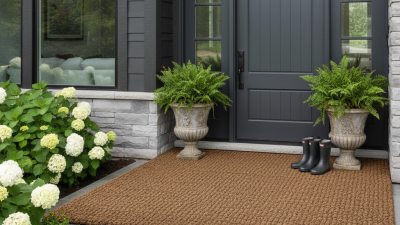
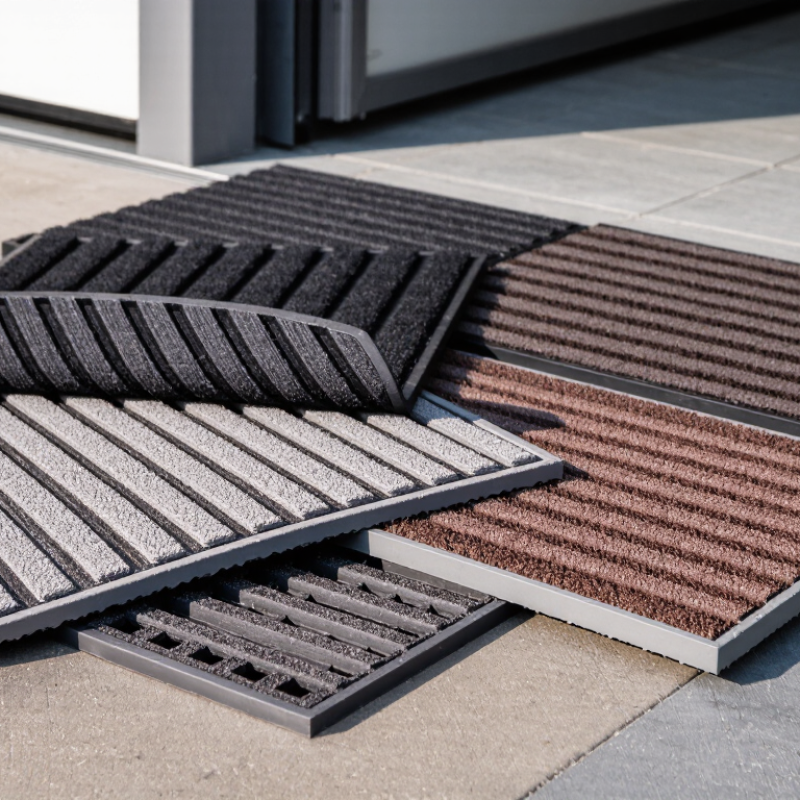
Ribbed outdoor door mats need more than attractive grooves. Their material decides grip, drainage, comfort, and service life. PVC mats are lightweight, flexible, and easy to clean. They suit covered entrances with moderate foot traffic. Rubber offers stronger traction and better resistance to rain, mud, and repeated use. It can feel heavy, but that weight reduces movement. Polypropylene dries quickly and resists fading. Its molded ribs can scrape sand effectively, although thin designs may flatten sooner. Coir provides a natural, textured surface that removes dry dirt well. However, it absorbs moisture and may shed fibers in wet conditions.
A reliable China supplier should explain density, backing structure, rib depth, edge finishing, and test conditions. Ask for samples before placing a large order. Place them outdoors for several days. Check curling, odor, drainage, and color changes after rain. The best choice depends on entrance exposure, cleaning habits, and expected traffic. No material wins every test. That is easy to forget. Even a well-made mat may perform poorly when its backing suits smooth floors but not rough concrete.
Tips: Match rubber or PVC with exposed doorways and heavy traffic. Choose polypropylene for fast drying and frequent cleaning. Use coir near sheltered entrances. Measure the doorway carefully, and confirm thickness before production. Request packaging details too, because compressed mats can arrive with lasting bends.
Typical density ranges of the main materials used in ribbed outdoor door mats. Lower-density materials are generally lighter, while higher-density materials may provide greater mass and stability. Actual values vary by formulation, fiber structure, and mat construction.
For buyers comparing a China top ribbed outdoor door mat supplier, four specifications deserve practical attention: rib height, unit weight, water drainage, and abrasion cycles. Commercial mat testing commonly measures rib height in millimetres, because deeper ribs can scrape more dirt from shoes. However, excessive height may feel unstable at a doorway. A useful purchasing range is often 8–15 mm, depending on traffic and backing design.
Unit weight indicates material density, but it does not prove durability alone. Request weight per square metre, not only weight per piece. Drainage should be tested after simulated rainfall, with standing water recorded beneath the mat. ASTM D3884 provides a recognized abrasion-testing method, while ISO 12947 offers cycle-based wear evaluation for textile surfaces. Neither standard creates one universal outdoor-mat pass level. That matters.
Supplier claims need context. A mat surviving 10,000 abrasion cycles may perform differently under sand, grit, or wet footwear. Ask for test photos, sample dimensions, load pressure, and failure criteria. Industry purchasing surveys consistently identify durability and maintenance as major commercial-flooring concerns, but real doorway conditions remain difficult to reproduce. I would also question unusually high cycle numbers. More testing is not always better testing. A dense 3–5 kg/m² mat with open drainage channels may outperform a heavier mat that traps water and fine soil.
Choosing a ribbed outdoor door mat supplier requires more than checking product photos. I ask factories about monthly output, molding machines, worker shifts, and storage space. A capable facility should explain how it controls rib depth, edge trimming, backing adhesion, and surface consistency. Request recent production images and a live video tour. Details matter.
MOQ can vary by material, size, color, and packaging. Some factories accept a small trial order, while custom colors may require several hundred pieces. Confirm whether the MOQ applies per design or across mixed sizes. I also request a written sample approval process. Samples can look excellent, yet bulk production may show uneven ribs or curling edges.
Lead time should include material preparation, sampling, production, inspection, and export packing. For standard items, a supplier may quote two to four weeks, but holiday workloads can change that estimate. Build in buffer time. I learned this the hard way. Ask for a production schedule with milestone dates, not only one shipping promise. ISO 9001 certification indicates a documented quality management system, but it does not guarantee perfect mats. Check the certificate scope, validity, inspection records, and corrective-action process. A supplier that discusses defects openly often appears more reliable than one offering effortless assurances.
A reliable ribbed outdoor door mat supplier should show measurable performance, not only attractive product photos. ASTM F1637 provides practical guidance for safer walking surfaces, including stable placement, controlled edges, drainage, and reduced trip hazards. We inspect each mat on a flat test area, then check curling after repeated moisture exposure. Small details matter. A raised edge can catch a shoe.
Slip resistance also requires structured evaluation. Under the EN 13552 classification approach, we examine the ribbed surface in dry and wet conditions. Water is applied across the mat, while test footwear moves at controlled angles and pressure. The rubber compound, rib height, and backing design can change the result. One formula may perform well outdoors but feel unstable on polished indoor flooring.
REACH compliance involves more than signing a supplier statement. We review material declarations, screen relevant restricted substances, and request laboratory evidence when raw materials change. This process covers rubber, pigments, plasticizers, and backing layers. Production records should connect test samples with specific batches. That link supports traceability.
Performance can vary with temperature, dirt, and heavy traffic. Our own testing is useful, but it cannot represent every entrance. Field feedback sometimes reveals water pooling or movement that laboratory checks miss. Those findings should lead to design changes, not excuses. A dependable supplier explains limitations clearly and keeps retesting when materials or rib patterns change.
China Top Ribbed Outdoor Door Mat Supplier?
Choosing the Best Supplier by QC Data, Pricing, Packaging, and Incoterms
A reliable supplier should provide measurable quality data, not only attractive samples. Request rib height, pile weight, backing thickness, absorbency, colorfastness, and dimensional tolerance. For outdoor mats, inspect rubber or PVC backing adhesion after bending and moisture exposure. Ask for an AQL inspection report with defect photos and production quantities. Small details matter.
The lowest unit price may not be the lowest buying cost. Compare material specifications, tooling fees, inspection charges, inland transport, and replacement policies. A quotation should state the price basis clearly, such as EXW, FOB, CIF, or DDP. Confirm the named destination and responsibility for customs clearance, duties, and delivery. Otherwise, the final cost can change sharply.
Packaging deserves physical testing. Check whether each mat keeps its shape after rolling, stacking, and a long sea shipment. Use carton drop tests and measure carton compression strength. A sample carton may look perfect, while mass production varies. That is a real risk. Request pre-shipment photos, random carton checks, and batch identification labels. Still, no report replaces independent inspection; even a careful supplier can miss uneven edges or weak backing in a busy production run.
| Evaluation Dimension | Supplier Profile A | Supplier Profile B | Supplier Profile C | Preferred Reference |
|---|---|---|---|---|
| Product construction | Polypropylene ribbed surface with PVC backing | Polyester ribbed surface with TPR backing | Polypropylene ribbed surface with recycled PVC backing | PP surface with stable, non-slip backing |
| Standard size and tolerance | 40 × 60 cm; ±1.0 cm | 40 × 60 cm; ±0.8 cm | 40 × 60 cm; ±1.2 cm | Confirm size tolerance before mass production |
| Average unit weight | 900 g; ±5% | 1,050 g; ±5% | 850 g; ±7% | 900–1,050 g for a durable outdoor model |
| Colorfastness to light | Grade 4, tested to ISO 105-B02 | Grade 4–5, tested to ISO 105-B02 | Grade 3–4, supplier declaration | Minimum Grade 4 with test report |
| Water absorption | Below 10% after 24-hour immersion | Below 8% after 24-hour immersion | Below 12% after 24-hour immersion | Below 10% and no backing separation |
| Backing slip resistance | Dry coefficient: 0.62; wet coefficient: 0.48 | Dry coefficient: 0.68; wet coefficient: 0.53 | Dry coefficient: 0.55; wet coefficient: 0.41 | Wet coefficient of at least 0.45 |
| Abrasion resistance | Passes 20,000-cycle test; no exposed backing | Passes 30,000-cycle test; minor surface fuzzing | Passes 15,000-cycle test; visible wear | At least 20,000 cycles with no structural damage |
| Odor and restricted substances | Low odor; REACH and CPSIA declaration available | Low odor; REACH, RoHS, and CPSIA documents available | Low odor; supplier declaration only | Independent test report for destination market |
| Pre-shipment inspection | AQL 2.5 major / 4.0 minor; inspection record included | AQL 1.5 major / 2.5 minor; inspection record included | Visual inspection; no stated AQL level | AQL 1.5 major / 2.5 minor or buyer-approved standard |
| Indicative price at 1,000 pieces | US$2.35 per piece, FOB China port | US$2.78 per piece, FOB China port | US$2.08 per piece, FOB China port | Compare on equal specifications and packaging |
| Sample charge and refund policy | US$35 sample charge; refundable after 1,000-piece order | Free standard sample; freight paid by buyer | US$25 sample charge; non-refundable | Approve a physical sample before production |
| Minimum order quantity | 500 pieces per color | 1,000 pieces per color | 300 pieces per color | 500 pieces or lower for market testing |
| Individual packaging | Recycled PE bag with barcode label | Paper belly band with recycled PE protective sleeve | Standard PE bag without barcode | Retail-ready label and packaging specification |
| Export carton configuration | 10 pieces/carton; 5-ply carton; approx. 9.8 kg/carton | 8 pieces/carton; 5-ply carton; approx. 8.9 kg/carton | 12 pieces/carton; 3-ply carton; approx. 10.5 kg/carton | Keep gross carton weight below 20 kg where possible |
| Carton drop-test performance | Passes 80 cm drop test; no product damage | Passes 100 cm drop test; no carton opening | Passes 60 cm drop test; minor carton deformation | Minimum 80 cm drop test with photographic evidence |
| Estimated loading efficiency | Approximately 3,200 pieces per 20-foot container | Approximately 2,800 pieces per 20-foot container | Approximately 3,600 pieces per 20-foot container | Validate final carton dimensions with a loading plan |
| Production lead time | 25–30 days after deposit and artwork approval | 30–35 days after deposit and artwork approval | 20–25 days after deposit and artwork approval | Written production schedule with shipment deadline |
| Available Incoterms | FOB, FCA, CIF, and DDP quotation available | FOB and CIF quotation available | EXW and FOB quotation available | Use FOB for transparent comparison; request DDP separately |
| Payment terms | 30% deposit; 70% before shipment after inspection | 30% deposit; 70% against copy of bill of lading | 40% deposit; 60% before shipment | Link final payment to passed inspection and shipping documents |
| Weighted evaluation score | 84 / 100 | 91 / 100 | 73 / 100 | Select the highest verified score, not the lowest price |