Why Choose a Double-Ribbed Floor Mat for Commercial Use?
Commercial entrances face a steady mix of rainwater, grit, and hurried foot traffic. A Double-Ribbed Floor Mat can help scrape debris and manage moisture, while its raised channels provide a defined walking surface. Results depend on the mat’s material, placement, condition, and the floor beneath it. No mat removes every hazard.
The scale of workplace risk is real. The U.S. Bureau of Labor Statistics recorded 885 fatal work injuries involving falls, slips, or trips in 2023. That figure covers many settings and causes; it is not evidence that any single mat prevents injuries. Still, it explains why facility managers assess entrances, cleaning routines, and walking surfaces together. Small details matter. A curled edge or saturated mat can undermine an otherwise sensible setup.
Russell J. Kendzior, founder of the National Floor Safety Institute and a floor-safety author, has emphasized the role of floor conditions and maintenance in slip prevention. A practical summary of that guidance is: “Matting supports a safety program; it does not replace maintenance.” This is a paraphrase, not a verified verbatim quotation. For commercial buyers, the useful question is specific: will a double-ribbed design suit the entrance’s traffic, cleaning schedule, and exposure to moisture? This guide examines those trade-offs, including durability, placement, and upkeep. It also recognizes a limitation: even a well-chosen mat needs regular inspection.
What Defines a Double-Ribbed Floor Mat?
What Defines a Double-Ribbed Floor Mat?
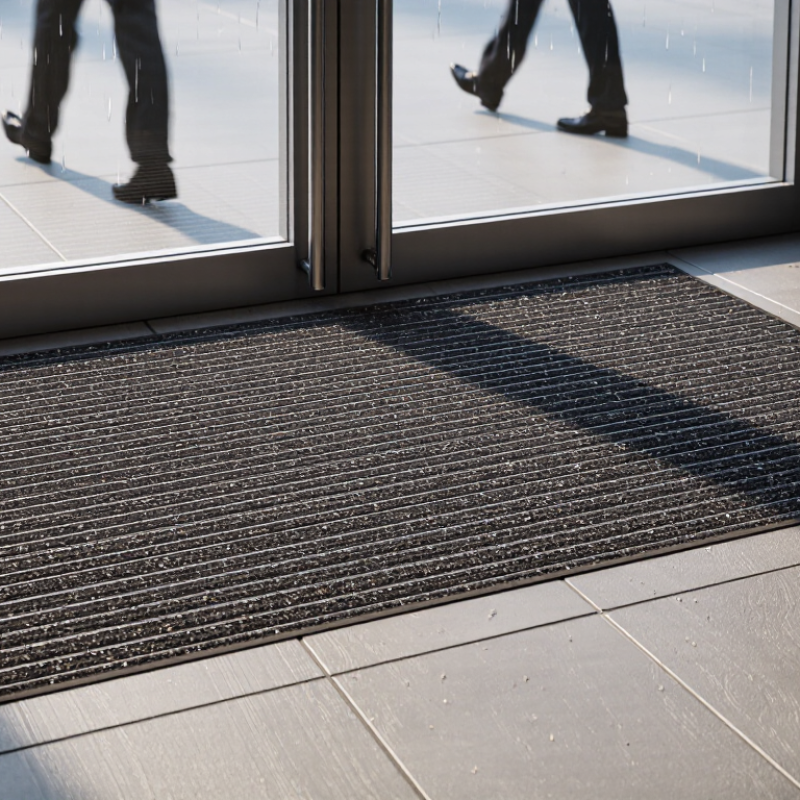
A double-ribbed floor mat has a raised surface made of two repeating rib patterns. The ridges create channels that can catch loose grit and help move water away from shoe soles. “Double-ribbed” can describe different profiles, so check the actual mat rather than relying on the label. Some have closely spaced ridges; others use wider channels. Feel the surface.
For commercial settings, the rib direction matters. A cross-ribbed pattern can offer scraping contact from more than one walking direction, while a single-direction design may suit a defined entrance path. Liberty Mutual’s 2024 Workplace Safety Index estimated that same-level falls cost U.S. businesses $10.5 billion, based on workers’ compensation data. That figure covers falls broadly; it does not prove that any mat prevents them. The detail matters.
Inspect the mat where people actually walk: doorways, checkout lanes, and damp service entrances. Ridges should stay visible and intact, without flattening or trapping debris that staff cannot remove. Check how the mat sits on the floor, too. A useful profile can still become a trip concern if an edge curls. The pattern is no magic fix. Choose for the traffic, moisture, and cleaning routine, then review performance in use.
How Do Double Ribs Improve Grip and Debris Control?
Double-ribbed commercial mats use raised ridges and the channels between them to manage foot traffic. The ridges provide repeated contact points under shoes, while the grooves give water and loose grit room to move. At an entrance, this can limit how far muddy water and small stones travel across the floor. It is a practical barrier, not a guarantee.
The U.S. Bureau of Labor Statistics’ 2023 Census of Fatal Occupational Injuries recorded 885 fatal work injuries involving falls, slips, or trips. That figure does not show that mats prevent accidents, but it highlights why floor transitions deserve attention. Grip depends on more than rib design: spacing, mat stability, footwear, and floor condition all matter. Tighter grooves may catch fine debris; wider channels can accommodate larger grit, but may collect grime.
Maintenance matters. Still, ribs are not magic. Check the mat after busy shifts; damp dust packed between ridges can hinder drainage. Choose a mat that lies flat and suits the site’s traffic and moisture. OSHA’s walking-working-surface guidance emphasizes keeping floors clean and dry. A ribbed mat can support that routine, but it cannot replace prompt spill cleanup. Lifting a corner for inspection can reveal what the top surface hides.
Which Commercial Settings Benefit from Double-Ribbed Mats?
Double-ribbed floor mats are useful where people track in water, dust, or light debris throughout the day. Their raised channels can help collect moisture and grit beneath foot traffic, while the textured surface provides a more secure step than a smooth floor. That matters.
Retail entrances often benefit during rainy weather, especially near automatic doors where wet footprints quickly spread. In restaurant kitchens, mats can add traction around sinks and prep stations, provided staff can lift and clean them regularly. They may also suit workshops, service counters, and staff corridors where shoes carry fine debris from one area to another. In loading zones, choose a mat suited to the expected traffic and equipment; not every ribbed mat is designed for heavy carts.
The right setting depends on more than appearance. Check the mat’s thickness, edge profile, cleaning requirements, and resistance to oils or cleaning agents before placing it. A loose edge can become a trip concern, and trapped moisture can create an odor if the mat is left in place. Not everywhere. A mat can help manage tracked-in dirt, but it cannot correct poor drainage or replace routine floor cleaning. In practice, the simplest test is to observe where water and debris actually gather during a busy shift.
How Do Materials and Construction Affect Mat Performance?
In a busy entrance, a double-ribbed mat works through contact and drainage. Its raised channels scrape dirt from shoe soles, while the grooves give water somewhere to collect. The pattern helps, but it cannot compensate for a poor material choice.
Flexible rubber often stays stable under repeated foot traffic, while some PVC mats are lighter and easier to move. Suitability depends on the site’s temperatures, cleaning routine, and exposure to oils or detergents. Not every entrance is alike.
Thickness, rib height, and backing matter too. Deeper ribs may hold more debris, but they can also make rolling carts harder to push. A firm backing can limit shifting, provided the floor is clean and dry.
Check whether edges lie flat; curled corners invite trips and collect grit. Construction quality shows in consistent rib spacing and secure layer bonding. Small details matter.
Product specifications can be incomplete, so compare them with the actual conditions at the doorway. A mat that performs well in a dry lobby may need more frequent cleaning near a rainy loading entrance.
That trade-off is easy to overlook.
Cleaning access matters. Cleaning access matters.
How Should Businesses Select and Maintain a Double-Ribbed Mat?
A double-ribbed mat should match the entrance, floor surface, and actual foot traffic—not just the doorway’s appearance. Measure the full walking path, including space for people to step off without catching an edge. Choose a thickness that sits securely under doors and a backing suited to the floor. Wet or oily work areas may need a different surface and cleaning plan than a dry lobby. Fit matters.
Liberty Mutual’s 2024 Workplace Safety Index estimated that same-level falls cost U.S. employers $10.5 billion in direct costs in 2022. That figure makes mat selection worth careful attention, but a mat cannot prevent every slip. Check that ribs run across the direction of travel, and inspect edges for curling, tears, or movement. Small detail. A misplaced mat can create its own trip hazard.
Set a cleaning schedule based on soil and traffic: vacuum or shake out dry debris, then use a compatible cleaner for residue. Follow the mat maker’s care instructions, and let the mat and floor dry fully before putting it back. Check underneath, too; trapped grit can scratch flooring, while dampness may linger unnoticed. If the mat shifts or stays wet, reconsider its location or backing. Regular inspection is easy to postpone. That’s a real maintenance weakness.
Why Choose a Double-Ribbed Floor Mat for Commercial Use?
Raised ribs help scrape dirt and moisture from footwear, making double-ribbed mats a practical option for busy entrances and work areas. A regular care routine helps keep the mat effective and safe.
Suggested maintenance schedule: Remove loose debris daily, clean the mat weekly, and inspect the ribs and backing monthly. These are practical planning intervals, not fixed standards; adjust them to foot traffic, weather, and the amount of soil tracked indoors. Replace the mat if it becomes damaged or no longer lies flat.